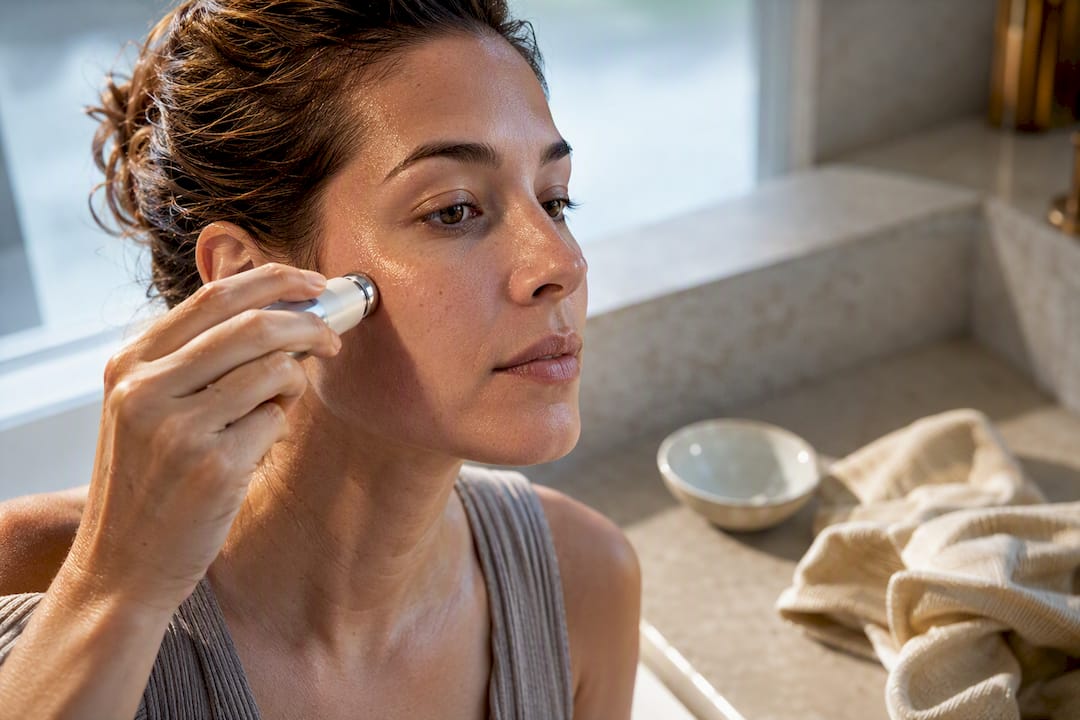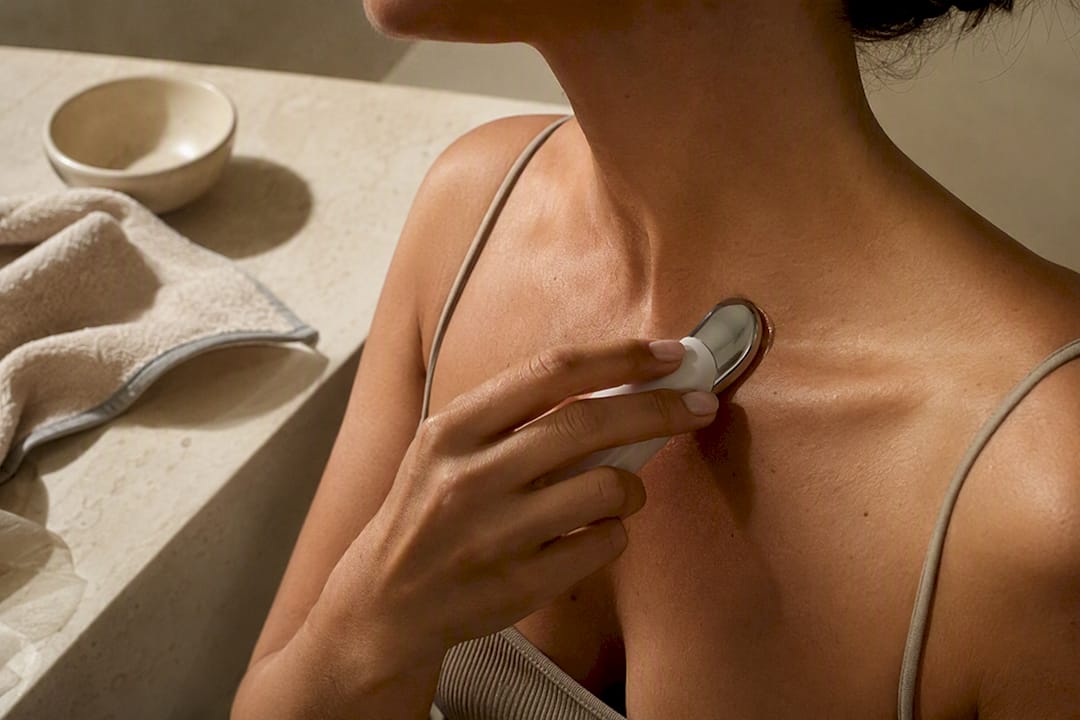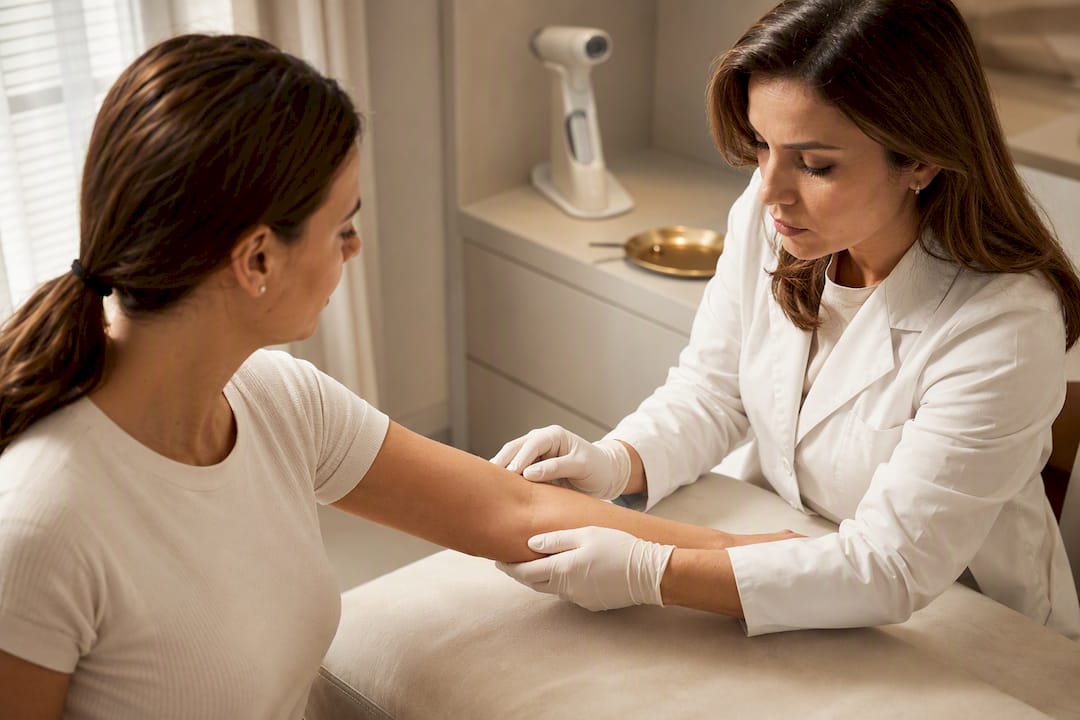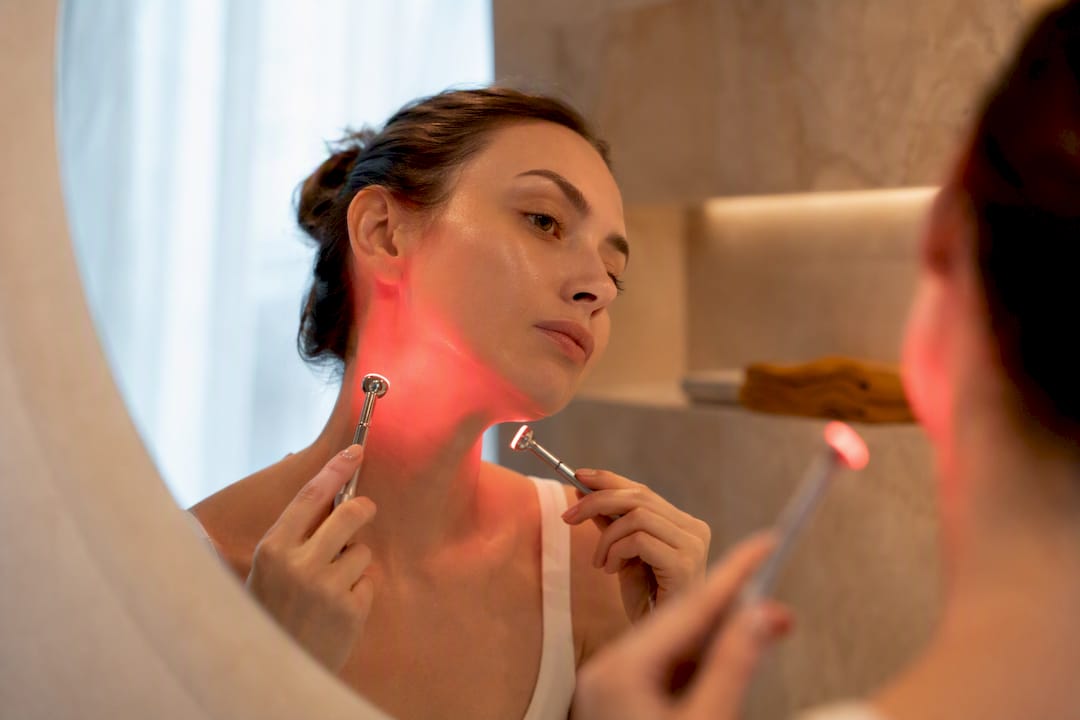
Red light (630–660 nm) and near-infrared (810–850 nm) are the most evidence-backed wavelengths for collagen stimulation, skin repair, and inflammation reduction. Blue light is commonly used for acne because it targets the bacteria behind breakouts at the skin surface. Every other color — green, yellow, purple — have a narrower or less conclusive body of evidence, and many devices market them aggressively without disclosing the one number that actually matters: the peak wavelength in nanometers.
Before you read another product description, check three things: peak wavelength (nm), irradiance (mW/cm²), and session dose guidance. If a mask lists “7 colors” but none of those specs appear anywhere on the page, that is a red flag, not a feature.
Quick match guide:
- Anti-aging and collagen: Red (630–660 nm) or red paired with near-infrared (810–850 nm)
- Active acne: Blue (~415 nm), ideally combined with red for faster healing
- Redness and soothing: Yellow/amber (570–590 nm) or red at lower irradiance
Table of Contents
- What each LED mask color actually does for your skin
- How LED light therapy actually works on skin
- How to use an LED mask safely and effectively
- How to choose an LED mask: the buyer checklist
- Do multi-color masks or combined modes add real benefit?
- What dermatologists and clinical studies actually say
- Key Takeaways
- The wavelength gap most buyers never close
- Glowera LED devices that meet the buyer checklist
- Useful sources and further reading
What each LED mask color actually does for your skin
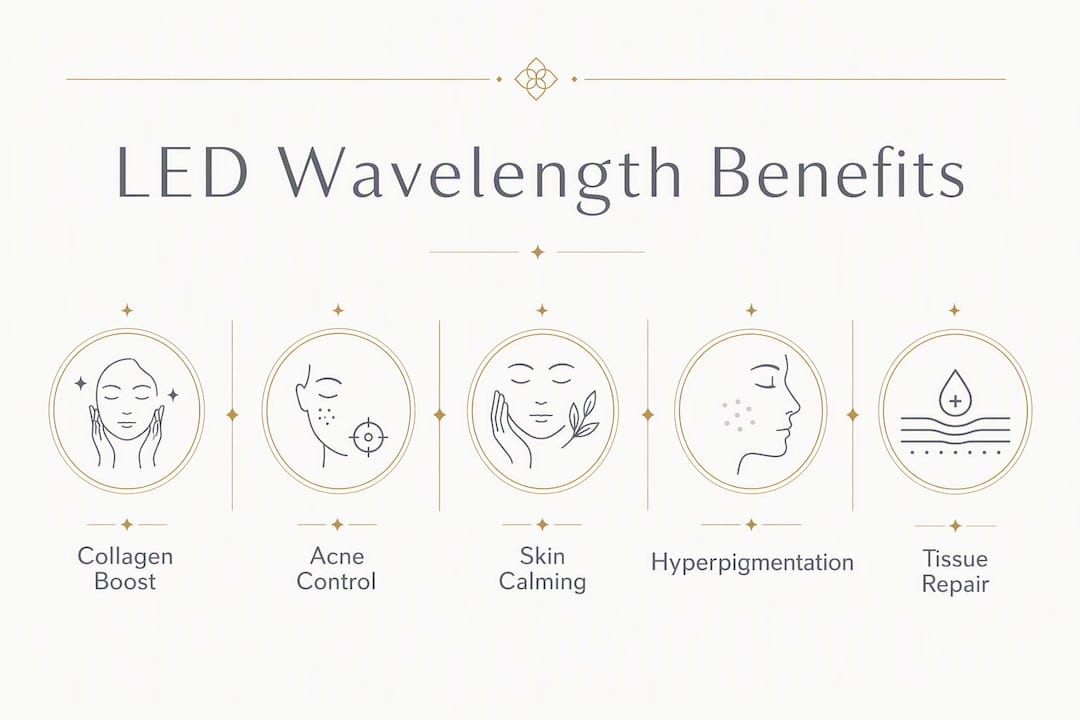
The color you see on a mask is a packaging shortcut. The real variable is the peak wavelength in nanometers, which determines how deep the light penetrates and which biological targets it reaches. Here is a color-by-color breakdown with the specs that matter.
| Color | Wavelength Range | Core Benefit | Evidence Strength |
|---|---|---|---|
| Red | 630–660 nm | Collagen, repair, inflammation | Strong |
| Near-infrared | 810–850 nm | Deep tissue repair, circulation | Strong |
| Blue | 415–470 nm | Acne bacteria reduction | Strong |
| Yellow/Amber | 570–590 nm | Redness, lymphatic support | Moderate |
| Green | 520–550 nm | Pigmentation, calming | Limited |
| Purple/Violet | ~400–430 nm | Acne + mild repair (combined) | Emerging |
Red light (630–660 nm)
Red light in the typical 630–660 nm range is among the most studied visible wavelengths for anti-aging applications. It penetrates into the dermis, where it stimulates fibroblasts to produce collagen and elastin, and it reduces inflammatory cytokines that contribute to redness and uneven texture. Clinical protocols typically use this range for wound healing, post-procedure recovery, and general skin rejuvenation. At-home sessions usually run 10–20 minutes, three to five times per week, depending on the device’s irradiance output.
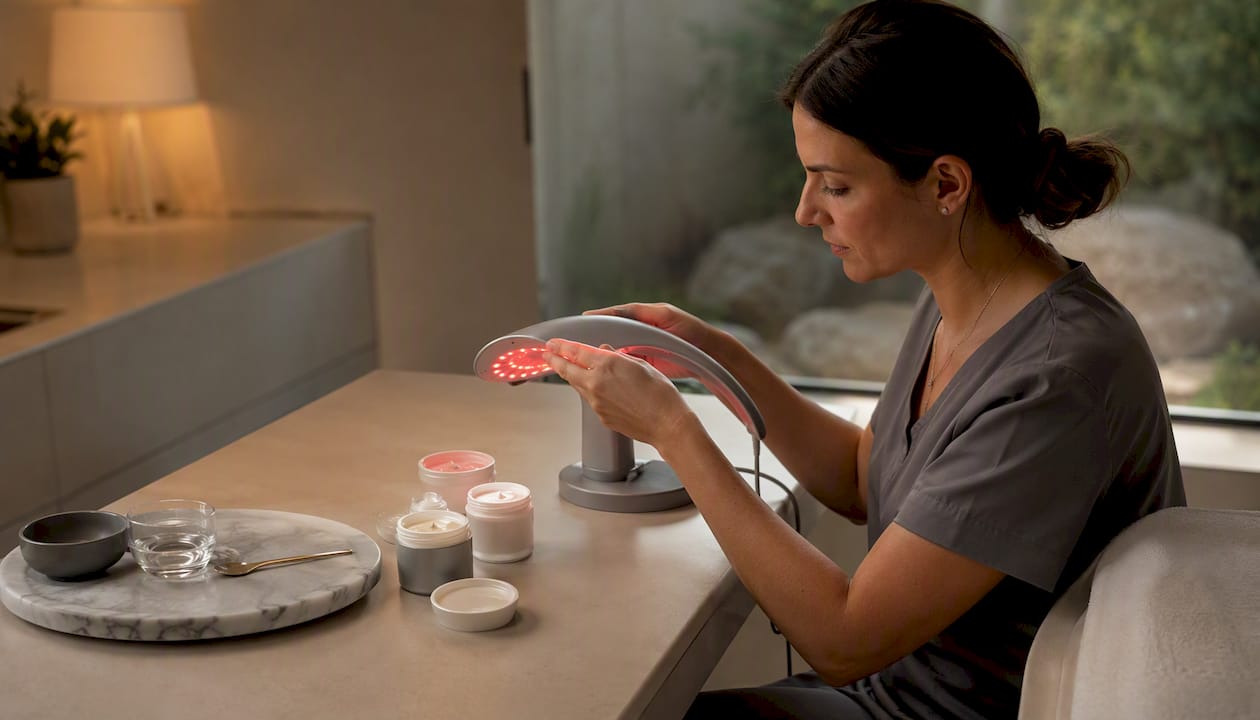
Near-infrared light is invisible to the eye but reaches deeper than visible wavelengths. Typically in the 810–850 nm range, it penetrates past the dermis into subcutaneous tissue, supporting circulation and accelerating tissue repair. Quality masks often pair red and NIR specifically because they act at different depths: red handles the dermal layer, NIR goes further. If you are targeting fine lines and want the most complete coverage, a red-plus-NIR device is worth the extra scrutiny on the spec sheet.
Blue light (~415–470 nm)
Blue light near 415 nm targets Cutibacterium acnes, the bacteria most associated with inflammatory acne. It works by activating porphyrins inside the bacterial cells, which then produce reactive oxygen species that destroy the bacteria. The effect is surface-level — blue light does not penetrate deeply — so it addresses the bacterial load without reaching the deeper inflammation. That is exactly why combining it with red produces better outcomes than using either alone.

Yellow/amber light is generally placed in the 570–595 nm range, with at-home devices often targeting the lower end of this spectrum. Yellow light is thought to support lymphatic drainage, reduce superficial redness, and calm reactive skin. The evidence base is moderate rather than strong, meaning it shows promise in smaller studies but lacks the volume of red or blue light research. It is a reasonable addition for people with rosacea-prone or sensitive skin, but it should not be the primary reason you buy a mask.
Green (520–550 nm)
Green light is marketed heavily for hyperpigmentation and calming. The evidence is limited. Some studies suggest it may influence melanocyte activity and reduce the appearance of dark spots over time, but the effect sizes are small and the research is not yet consistent enough to make confident claims. If pigmentation is your main concern, a dermatologist-prescribed topical (think niacinamide, azelaic acid, or a retinoid) will outperform green light therapy at home. Green can be a useful complement, not a replacement.
Purple/Violet (~400–430 nm)
Purple light sits at the edge of the visible spectrum, overlapping with blue. Most devices that offer it are essentially running a blue-dominant wavelength with a slight red component mixed in, which is why some brands position it as a “combination” mode for acne plus repair. The evidence for purple as a distinct therapeutic wavelength is emerging rather than established. Treat it as a blue-light variant with modest anti-inflammatory support, not a separate clinical category.
On dose and duration: Most home devices operate at irradiance levels generally under clinical devices, producing gradual effects over repeated sessions. Session duration to achieve clinical doses varies based on irradiance. Session time alone tells you nothing without irradiance.
How LED light therapy actually works on skin
Wavelength determines depth and biochemical target. Power and dose determine how large the effect is. Those two sentences cover most of what you need to understand about LED light therapy, technically called photobiomodulation (PBM).
Photobiomodulation describes the process by which specific wavelengths of light are absorbed by chromophores in cells, triggering biochemical responses without generating heat. For red and near-infrared light, the primary chromophore is cytochrome c oxidase, an enzyme in the mitochondrial electron transport chain. When it absorbs red or NIR photons, it increases ATP production, reduces oxidative stress, and upregulates growth factors that signal fibroblasts to produce more collagen. Research published in PMC supports this mitochondrial pathway as the core mechanism behind red and NIR skin benefits.
Blue light works differently. It does not target mitochondria. Instead, it activates porphyrins inside Cutibacterium acnes bacteria, generating reactive oxygen species that rupture bacterial cell membranes. The effect is photochemical and largely confined to the skin surface, which is why blue light clears active lesions but does not address the deeper inflammatory response that keeps acne cycling.
Penetration depth by wavelength (approximate):
- Blue (415–470 nm): epidermis and upper dermis, ~0.5–1 mm
- Red (630–660 nm): dermis, ~2–3 mm
- Near-infrared (810–850 nm): subcutaneous tissue, ~5–10 mm
Pro Tip: Higher wavelength does not automatically mean better results. Match the wavelength to the depth of the target tissue. Acne bacteria live at the surface, so blue’s shallow penetration is an advantage, not a limitation.
How to use an LED mask safely and effectively
Follow your device’s specs first. General guidance for at-home masks is to use them regularly for appropriate session lengths based on the manufacturer’s instructions, which depend on the device’s irradiance and your skin goals.
Step-by-step routine:
- Cleanse thoroughly. Remove all makeup, SPF, and surface oils. Light does not penetrate through product buildup, and some ingredients (especially photosensitizing actives like retinoids or AHAs) can increase irritation under LED exposure.
- Apply eye protection. Use the goggles or eye shields supplied with your device. Never skip this step, even for masks marketed as “eye-safe.” Direct LED exposure to the eyes carries real risk.
- Position the mask. Sit or lie back. The mask should sit flush against the skin; gaps reduce energy delivery.
- Run the session. Set the timer per the manufacturer’s guidance. Do not extend sessions thinking more is better; excess dose can cause irritation without adding benefit.
- Post-session care. Apply a hydrating serum or moisturizer immediately after. Skin is more receptive to topical absorption right after LED treatment. Avoid retinoids or exfoliating acids for at least a few hours post-session.
Signs to stop and consult a dermatologist: persistent redness lasting more than 30 minutes after a session, new breakouts in areas that were previously clear, stinging or burning during treatment, or any change in existing moles or lesions.
LED therapy is not appropriate for everyone. Contraindications include use of photosensitizing medications (certain antibiotics, retinoids, some antidepressants), active inflammatory skin conditions, a history of photosensitivity disorders, and some systemic conditions. When in doubt, check with a clinician before starting.
Pro Tip: Dose = irradiance × time. If your device’s irradiance is twice as high as another, you need half the session time to deliver the same energy. Always interpret advertised session times in the context of the device’s stated mW/cm².
How to choose an LED mask: the buyer checklist
The single most useful thing you can do before buying is look for the peak wavelength in nm and the irradiance in mW/cm². Masks that omit these specs are prioritizing marketing over transparency, regardless of how many LEDs or color modes they advertise.
Checklist: what to look for on any product page
- Peak wavelength(s) listed in nm (not just color names)
- Irradiance disclosed in mW/cm²
- Session dose guidance (J/cm² or time-plus-irradiance pairing)
- Eye protection included or explicitly addressed
- LED placement that covers the full face evenly (not clustered in one zone)
- Clear usage instructions and frequency guidance
- Warranty and brand authenticity documentation
Red flags to walk away from:
- “7 colors” or “11 modes” with no nm values anywhere on the page
- No irradiance figure, or irradiance listed only as “high/medium/low”
- Claims that the device “cures” acne or “reverses” aging
- No eye protection included or mentioned
- No usage instructions or contraindication guidance
On price: a higher price is sometimes warranted when a device discloses documented irradiance, pairs red with NIR, or has published clinical testing. It is not warranted simply because a device has more LEDs or more color options. A 200-LED mask with no nm disclosure is less useful than a 60-LED mask with a verified 660 nm peak and 50 mW/cm² irradiance.
Single-color vs. multi-color devices: if you have one focused concern (active acne, or purely anti-aging), a single-color device with strong specs is often the better buy. Multi-color masks make sense when you want flexibility across different concerns or plan to use different modes at different points in your routine.
Pro Tip: Copy the product’s nm and mW/cm² values into a simple notes file when comparing devices. Side-by-side, the spec gap between a transparent brand and a marketing-heavy one becomes obvious immediately.
Do multi-color masks or combined modes add real benefit?
Combining red and blue light consistently produces better acne outcomes than either wavelength alone. Blue light reduces the bacterial load at the surface; red light penetrates deeper to reduce inflammation and accelerate repair in the dermis. Using them together addresses both the cause and the inflammatory response simultaneously, which is why combination protocols appear repeatedly in clinical acne research.
Where the evidence gets thinner is with green, purple, and novelty multi-color modes. Adding a “cyan” or “orange” mode to a mask does not automatically make it more effective. If those wavelengths are not disclosed in nm and the device has no irradiance data, the extra colors are cosmetic, not therapeutic.
Practical use cases for combining colors:
- Active inflammatory acne: blue session first to reduce bacteria, followed by red or NIR to calm inflammation and support healing
- Post-procedure recovery: red and NIR together to accelerate repair and reduce redness
- Maintenance anti-aging: red alone or red-plus-NIR three to five times per week
- Sensitive or reactive skin: yellow/amber at low irradiance to soothe, followed by red for repair
Pro Tip: When a mask runs colors simultaneously rather than sequentially, check whether the irradiance figure covers the combined output or just one channel. Some devices split power across channels, meaning each wavelength delivers less energy per session than the headline number suggests.
What dermatologists and clinical studies actually say
Home LED masks can produce measurable improvements for certain skin concerns, but they are lower power than in-office devices. Cleveland Clinic guidance is direct on this: in-office LED treatments are more powerful and generally more effective than at-home devices, which may yield subtle improvements with regular use. “Subtle and gradual” is the honest expectation, not a dramatic transformation after two weeks.
Home LED devices can support skin health as part of a consistent routine, but they are not a substitute for professional treatment when a condition is moderate to severe. The gap in irradiance between a clinical device and a consumer mask is significant, and that gap translates directly into effect size.
Research published in PMC documents photobiomodulation effects on collagen synthesis and wound healing, supporting the biological plausibility of red and NIR light therapy. The American Academy of Dermatology notes that red light therapy has shown benefits for skin rejuvenation, though it emphasizes that results vary and the evidence for at-home devices specifically is still developing.
Dermatologist cautions and contraindications:
- Photosensitizing medications (tetracyclines, some antidepressants, isotretinoin) increase the risk of adverse reactions
- Active inflammatory conditions or open wounds may worsen with LED exposure
- Lupus, porphyria, and other photosensitivity disorders are contraindications
- Existing moles or lesions should be evaluated before starting regular LED use
- Pregnant individuals should consult a clinician before use
Blue light reduces acne-causing bacteria but does not address hormonal or systemic drivers of acne. Dermatologists recommend it as an adjunctive therapy for mild-to-moderate acne, not a standalone solution for severe or cystic cases. For anything beyond mild acne or surface-level skin maintenance, LED therapy works best alongside, not instead of, professional care.
This article is general information, not medical advice. Confirm current guidance with a dermatologist or qualified clinician before starting LED therapy, especially if you take prescription medications or have an existing skin condition.
Key Takeaways
Red and near-infrared light (630–850 nm) are the most evidence-backed wavelengths for collagen, repair, and inflammation; blue (~415 nm) is the strongest choice for acne; and no LED mask is worth buying without disclosed nm and irradiance specs.
| Point | Details |
|---|---|
| Check nm and irradiance first | Any mask without peak wavelength (nm) and irradiance (mW/cm²) on the product page is not worth buying. |
| Red and NIR for anti-aging | Red (630–660 nm) and near-infrared (810–850 nm) are the most evidence-backed wavelengths for collagen and repair. |
| Blue for acne, combined for best results | Blue (~415 nm) targets acne bacteria at the surface; pairing it with red improves outcomes by addressing deeper inflammation. |
| Expect gradual results | Home devices are lower power than clinical systems; consistent use over weeks produces subtle, measurable improvement. |
| Glowera LED devices | Glowera carries CurrentBody LED masks with disclosed wavelengths and session guidance, meeting the key specs this checklist requires. |
The wavelength gap most buyers never close
Most people shopping for an LED mask spend their time comparing color counts and price points. The question they rarely ask is: what is the peak wavelength, and does this device actually deliver enough energy per session to do anything?
The marketing around LED masks has outpaced the science in one specific way: it has trained buyers to treat color variety as a proxy for quality. A mask with seven colors sounds more capable than one with two. But a device running a verified 660 nm at 50 mW/cm² will outperform a seven-color mask with no disclosed specs every single time, because the mechanism is photochemical, not aesthetic. The color you see is a side effect of the wavelength, not the therapy itself.
What I find genuinely useful about the red-plus-NIR pairing is that it mirrors how clinical protocols are designed: visible red handles the dermal layer, NIR goes deeper. That is not a marketing claim; it is a straightforward consequence of how different wavelengths interact with tissue at different depths. When a device pairs them and discloses both wavelengths and irradiance, that transparency is itself a signal worth paying attention to.
The realistic expectation for consistent home use is that visible changes in skin texture or tone typically require weeks of regular use. That timeline frustrates people who expect week-two results but aligns with how collagen remodeling actually works. Fibroblast stimulation is a slow biological process. The masks that work are the ones you use consistently, not the ones with the most impressive color wheel on the packaging.
Glowera LED devices that meet the buyer checklist
Glowera carries CurrentBody LED face masks with disclosed peak wavelengths, irradiance figures, and clear session guidance, which is exactly what the checklist above asks for. That transparency is rarer than it should be in this category.
The CurrentBody LED Red Light Face Mask specifies its wavelength and recommended session time directly on the product page, so you can verify it against the 630–660 nm range before you buy. The blue-light options follow the same format, with ~415 nm targeting confirmed for acne protocols. All devices ship with eye protection included, and Glowera stocks only 100% authentic products from verified brand partners.
If you are ready to match your skin goal to a specific wavelength and buy a device that actually shows you its specs, browse the full LED therapy range at Glowera and compare options side by side.
Useful sources and further reading
The sources below were used in this article and are worth bookmarking if you want to go deeper into the clinical literature or safety guidance. When researching any device, prioritize pages that disclose nm values and irradiance alongside marketing claims. These links are provided for further reading; they are not endorsements of any specific product. For medical concerns, consult a dermatologist.
- LED Light Therapy: How It Works, Colors, Benefits & Risks — Cleveland Clinic
- Photobiomodulation and collagen synthesis — PMC (NIH)
- Photobiomodulation mechanisms — PMC (NIH)
- Red light therapy safety and evidence — American Academy of Dermatology