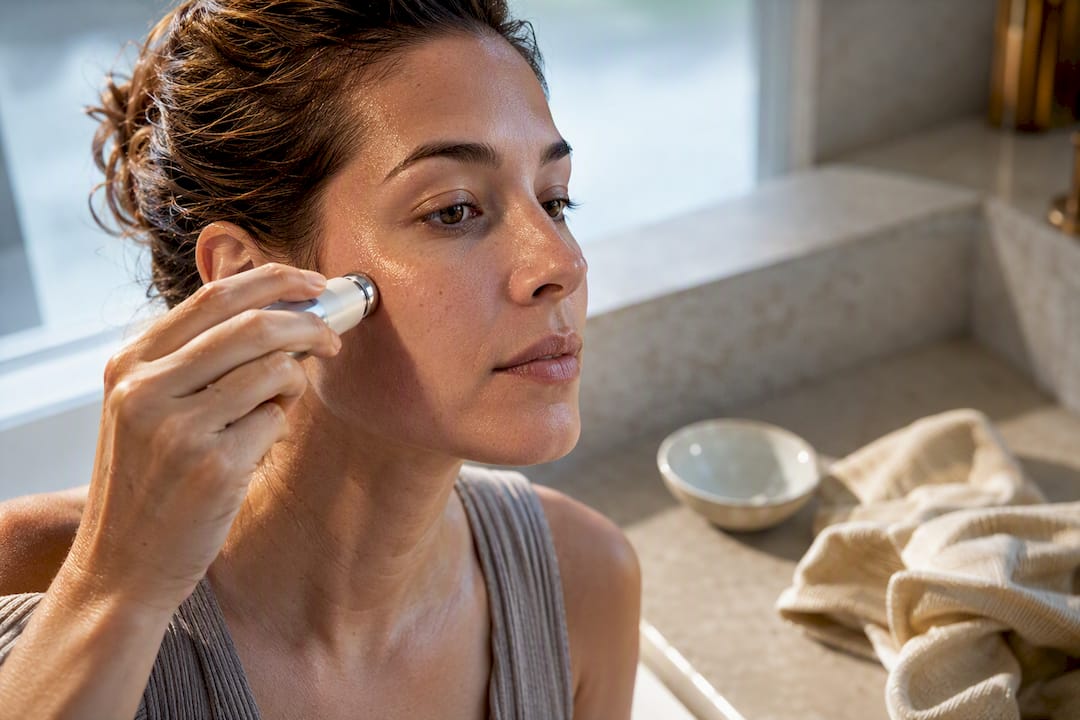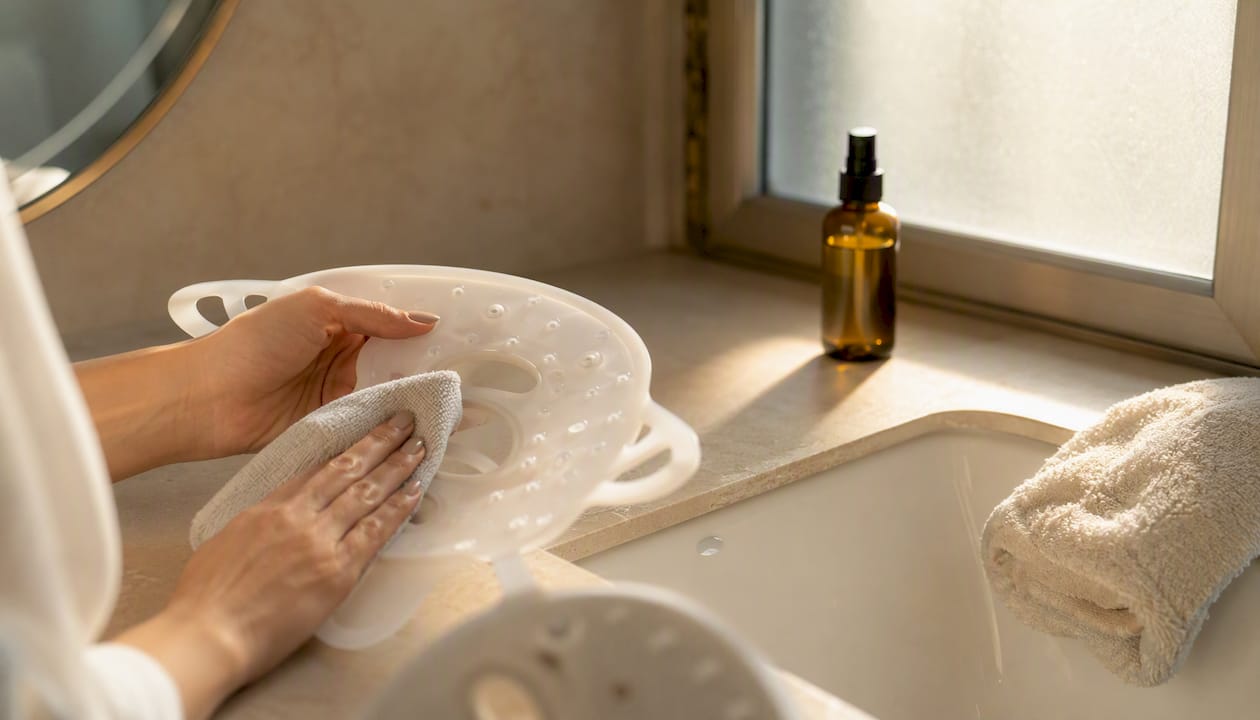
The safest way to clean an LED face mask is to power it off, unplug it, remove any detachable straps or silicone pads, and wipe all skin-contact surfaces with a soft, water-based or alcohol-free wipe. Then air-dry completely before storing. That sequence protects both your skin and the device.
Why does this matter? Any device pressing against your face during use picks up sebum, skincare residue, and bacteria. The American Academy of Dermatology notes that devices in direct skin contact should be kept clean to reduce the risk of irritation or infection. The FDA reinforces this from the device side: follow manufacturer instructions and never expose electrical devices to water. Those two principles together define the whole approach.
Three non-negotiables before you read further:
- Never submerge the mask housing in water, even briefly.
- Avoid harsh solvents like bleach, acetone, or ammonia near the LED lenses.
- Read your device’s manual before using any cleaner stronger than mild soap.
Key Takeaways
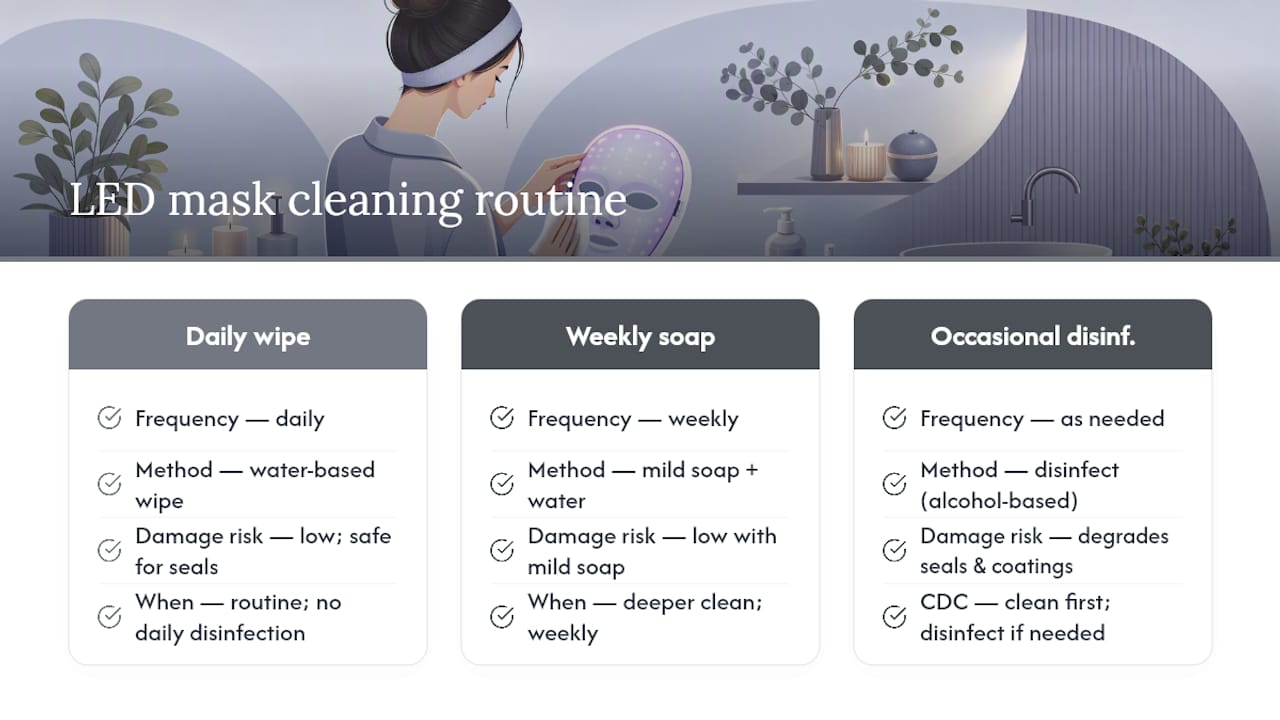
Cleaning an LED face mask safely requires a consistent routine: wipe after every use, do a mild soap clean weekly, and disinfect only when there is a genuine reason.
| Point | Details |
|---|---|
| Clean after every use | Wipe skin-contact surfaces with a water-based wipe or damp microfiber cloth after each session. |
| Weekly soap clean | Use mild, non-abrasive soap on a damp cloth weekly; follow with a plain-water wipe to remove residue. |
| Disinfect sparingly | Apply 70% isopropyl to a cloth only after shared use or visible contamination; never spray directly. |
| Never submerge | Water entering the housing causes corrosion and short circuits; air-dry fully after every clean. |
| Glowera LED devices | Glowera stocks authenticated LED masks from CurrentBody, FOREO, and Dr. Dennis Gross with full manufacturer care guidance. |
Table of Contents
- How to clean an LED face mask step by step
- What to use and what to avoid when cleaning
- How to dry, store, and maintain your mask between sessions
- How often should you clean, and when should you stop using the mask?
- Common cleaning mistakes and how to fix them
- What to check in your mask’s manual before you clean it
- The routine that actually holds up over time
- Glowera: LED masks built for people who take care of their devices
- Sources
How to clean an LED face mask step by step
A practical how-to guide for LED masks used by device care resources confirms that most masks share the same safe core routine: unplug, wipe, dry. Here is how to execute it properly.
-
Power off and unplug. Never clean the mask while it is connected to power. If the device uses a removable battery pack, take it out. This is the single step that prevents electrical hazard.
-
Remove detachable components. Silicone face pads, fabric straps, and nose bridges often detach. Pull them off and set them aside. The Homedics FAC series manual instructs users to clean removable attachments separately from the main unit, and most LED mask manuals follow the same logic.
-
Daily quick clean. Dampen a clean microfiber cloth with water or use a pre-moistened water-based wipe. Wipe all surfaces that touched your skin. Do not press hard on the LED lens panels. Do not soak the cloth to the point of dripping.
-
Weekly deeper clean. Add a small amount of mild, non-abrasive soap to a damp microfiber cloth. Work it gently over the interior surfaces, then follow with a second cloth dampened with plain water to remove any soap residue. Soap left on the housing can degrade seals over time.
-
Disinfect only when necessary. After shared use or if a skin infection was active, apply 70% isopropyl alcohol to a cloth first, then wipe. Never spray alcohol directly onto the device. Test an inconspicuous spot on the housing before wiping the full surface.
-
Clean detachable parts separately. Silicone pads can usually be rinsed under lukewarm water with mild soap. Check your manual to confirm. Let them dry completely before reattaching.
-
Air-dry fully. Set the mask on a clean, flat surface in a dust-free area. Give it at least 30 minutes before reassembling. Inspect the connectors and seals before plugging back in.
Pro Tip: Keep a dedicated pack of water-based wipes next to your mask. A 10-second wipe immediately after each session takes almost no effort and prevents residue from hardening on the lens surfaces.
What to use and what to avoid when cleaning
Choosing the right materials is where most people go wrong. The wrong cloth or cleaner can scratch LED lenses, strip protective coatings, or corrode internal contacts.
Use these:
- Microfiber cloths (soft, lint-free, non-abrasive)
- Water-based or alcohol-free pre-moistened wipes
- Mild, non-abrasive soap diluted in water for weekly cleaning
- Distilled water for rinsing, especially if your tap water is hard
- 70% isopropyl alcohol applied to a cloth for spot disinfection only
Avoid these:
- Bleach, ammonia, acetone, or any solvent-based cleaner
- Abrasive scrubbers, paper towels, or rough cloths
- Steel wool or any textured pad
- Spraying any liquid directly onto the device
- Submerging the mask or running it under water
The reasoning behind the avoid list is straightforward. Solvents strip the protective coatings on LED lenses, reducing light transmission over time. Microfiber cloths preserve optical clarity; abrasive materials scratch the lens surface and measurably reduce therapy effectiveness with repeated use. Excess water risks corrosion at the contacts and short circuits inside the housing.
On alcohol sprays: Spraying isopropyl alcohol directly onto electronics forces liquid into seams and connector ports. Always apply it to the cloth first. The CDC notes that 70% isopropyl is effective for disinfection, but proper application matters as much as concentration. A damp cloth gives you control; a spray does not.
How to dry, store, and maintain your mask between sessions
Getting the cleaning right is half the job. How you dry and store the mask determines whether moisture damage or physical wear shortens its life.
Drying:
- Air-dry on a clean, flat surface away from direct sunlight.
- Never use a hair dryer, oven, or any heat source to speed drying. Heat warps housings and degrades silicone seals.
- Allow at least 30 minutes, longer if you used a wetter cloth than usual.
Storage:
- Keep the mask in its original case or a soft pouch between sessions. This prevents dust from settling on the lens panels and protects the housing from scratches.
- Store in a cool, dry location away from humid environments like bathrooms.
- Avoid stacking heavy objects on top of the case.
Routine maintenance checks:
- Before each use, run a quick visual inspection: check strap condition, silicone seal integrity, LED lens surfaces for scratches or cloudiness, and cable insulation for cracks or kinks.
- Never bend or kink the power cord. Repeated stress at the connector point is a common cause of intermittent power failure.
- If you plan to store the mask for more than a few weeks, remove any detachable battery pack to prevent slow discharge or leakage.
The ALDI Visage device manual explicitly warns against allowing water to enter the housing and advises against harsh cleaners or sharp tools. That guidance reflects what most LED mask manufacturers converge on: the housing is the one part you protect most carefully, because once moisture or a scratch gets in, there is no reversing it.
How often should you clean, and when should you stop using the mask?
Cleaning frequency:
- After every use: Quick wipe of all skin-contact surfaces with a water-based wipe or damp microfiber cloth.
- Weekly: Mild soap clean to remove accumulated product buildup, followed by a plain-water wipe.
- After heavy sweating or heavy product use: Treat as a weekly clean regardless of schedule.
- When to disinfect: After shared use, after visible staining that could harbor bacteria, or if an active skin infection was present during use.
Red flags that mean stop using the mask now:
- Persistent skin irritation that appears or worsens after sessions, even after thorough cleaning
- Cracked or broken housing with exposed circuitry
- Visible moisture or condensation inside the lens panel
- LEDs flickering, dimming unevenly, or failing to light
- Any burning smell during use
The American Academy of Dermatology is clear: if a skin-contact device causes irritation that does not resolve, stop using it and consult a dermatologist. A clean mask that still irritates your skin is a signal about the device or your skin’s reaction to it, not a cleaning problem you can solve with a different wipe.
If you notice any of the red flags above, unplug the device immediately. Contact the manufacturer’s support line before attempting to use it again. For skin reactions that persist beyond a few days, see a dermatologist.
Common cleaning mistakes and how to fix them
Soaking the mask. The most damaging mistake. Water enters through seams and connector ports, corrodes contacts, and causes short circuits. If this happens, unplug immediately and air-dry for at least 72 hours before testing. Do not attempt to power it on while any moisture remains inside.
Using abrasive cloths or paper towels. Paper towels feel soft but are coarse enough to scratch LED lens surfaces. Switch to microfiber immediately. For existing light surface scratches on the housing (not the lenses), consult the manual for guidance. Scratched lenses cannot be restored.
Spraying cleaners directly onto the device. Liquid enters ports and seams. Always apply to the cloth first.
Reusing dirty wipes. A wipe used once carries oils and bacteria. Use a fresh one each session.
Using harsh solvents. If you have already used acetone or bleach on the housing, inspect the surface for discoloration or coating damage. If the lens surface looks hazy, the coating may be compromised. Contact the manufacturer.
Quick troubleshooting reference:
- Residue that won’t wipe off: Dampen a microfiber cloth with mild soap solution and let it sit on the spot for 30 seconds before wiping.
- Moisture inside the lens panel: Unplug, remove all detachable parts, and air-dry for 72 hours minimum. Do not use heat.
- LEDs flickering after cleaning: Check that all connectors are fully dry and properly seated. If flickering continues, contact manufacturer support.
- Faint smell after cleaning: Residual soap or wipe solution. Wipe again with a plain damp cloth and air-dry fully.
What to check in your mask’s manual before you clean it
General guidance covers most devices, but your manual has the final word. Before you use any cleaner beyond a plain damp cloth, find these specific items in your documentation.
- IP or water-resistance rating: Tells you whether any part of the device tolerates moisture exposure and to what degree.
- Permitted cleaners: Many manuals list exactly which agents are approved. If a cleaner is not on that list, do not use it.
- Removable-part instructions: Confirms which components detach and how to clean them (rinse, wipe, or hand-wash with soap).
- Electrical-safety cautions: Confirms battery removal steps and unplugging requirements before cleaning.
- Warranty and repair policy: Using a non-approved cleaner can void the warranty. Know this before you experiment.
Most manuals converge on the same three rules: unplug before cleaning, never immerse the housing, and wash removable pads separately. That alignment is what makes a single safe core routine work across most LED masks on the market.
Reading a manual line: A typical instruction reads: “Do not immerse. Wipe with a damp cloth. Use mild soap only. Do not use aggressive cleaning agents or sharp tools.” Map that directly to the step-by-step routine: damp microfiber cloth for daily cleaning, mild soap weekly, no solvents, no abrasives. The ALDI Visage manual uses exactly this phrasing, and it reflects the standard language across most consumer LED device manuals. If your manual says something more restrictive, follow the manual.
The CDC recommends cleaning with soap and water before disinfecting and avoiding unnecessary disinfectant use where cleaning alone suffices. That principle maps cleanly onto LED mask care: daily wipe, weekly soap clean, disinfect only when there is a real reason.
For device-specific cleaning instructions, Glowera recommends checking the manual before applying any disinfectant, particularly for masks with silicone or gel-coated lens panels that may react differently to alcohol than hard-plastic housings do.
The routine that actually holds up over time
The conventional wisdom on LED mask hygiene tends toward two extremes: either “wipe it down occasionally” or “disinfect after every single use.” Neither is right.
Disinfecting after every session is unnecessary and counterproductive. Repeated alcohol exposure degrades silicone seals and strips lens coatings faster than normal use would. The CDC’s own guidance is explicit: clean first, disinfect only when needed. For a personal device used only on your own clean skin, a daily water-based wipe and a weekly mild soap clean is the right balance.
What most guides understate is storage. A mask stored in a dusty drawer or left face-down on a bathroom shelf accumulates contamination between sessions that no post-use wipe fully addresses. The case matters. A soft pouch or the original box keeps the lens panels clean and the housing protected from the kind of minor impacts that crack seals over time.
Invest in a pack of good microfiber cloths and keep them dedicated to the mask. Wash the cloths themselves weekly. A clean cloth used on a clean mask, stored properly, will outlast the device’s warranty with no drama.
Glowera: LED masks built for people who take care of their devices

If you are already this careful about cleaning your LED mask, you deserve a device that is built to the same standard. Glowera carries a curated selection of LED therapy masks and red-light devices from brands like CurrentBody, FOREO, and Dr. Every product page includes the manufacturer’s care instructions, so you are never guessing about what your specific device can handle.
The difference between a mask that lasts two years and one that lasts five often comes down to build quality and how well the user knows the device. Glowera’s team is available to help you match the right mask to your skin goals and answer care questions before and after purchase. Browse the full LED skincare collection and find the device worth taking care of.
Sources
The guidance in this article draws on the following authoritative sources. Check the originals to verify safety standards or locate your device’s specific manual.