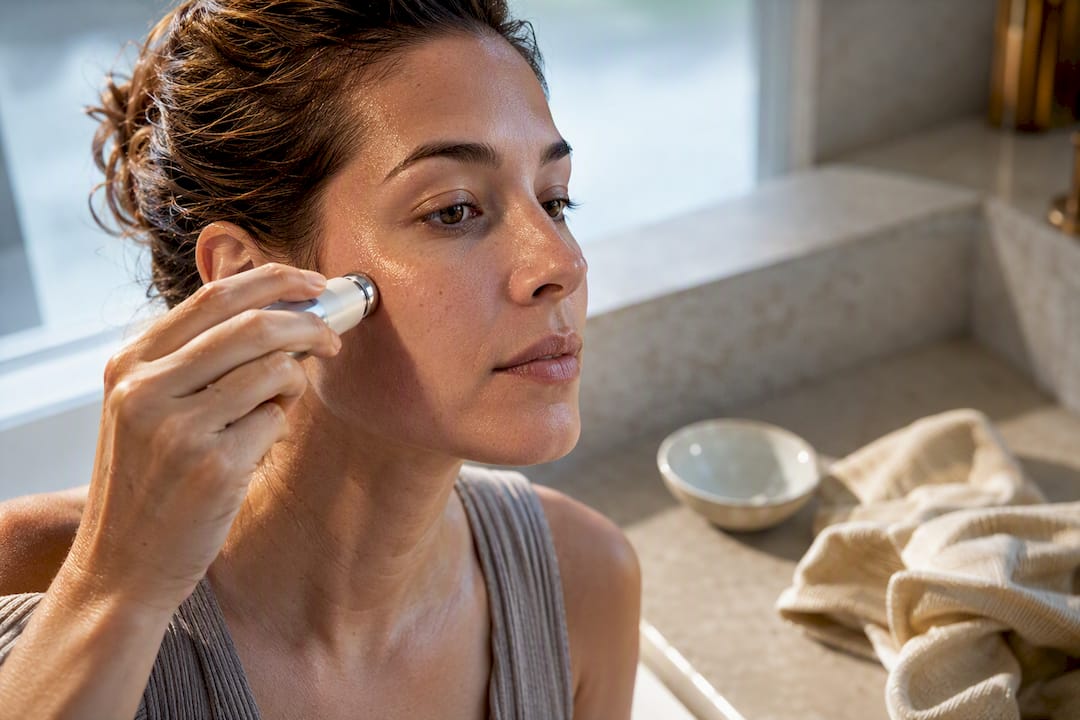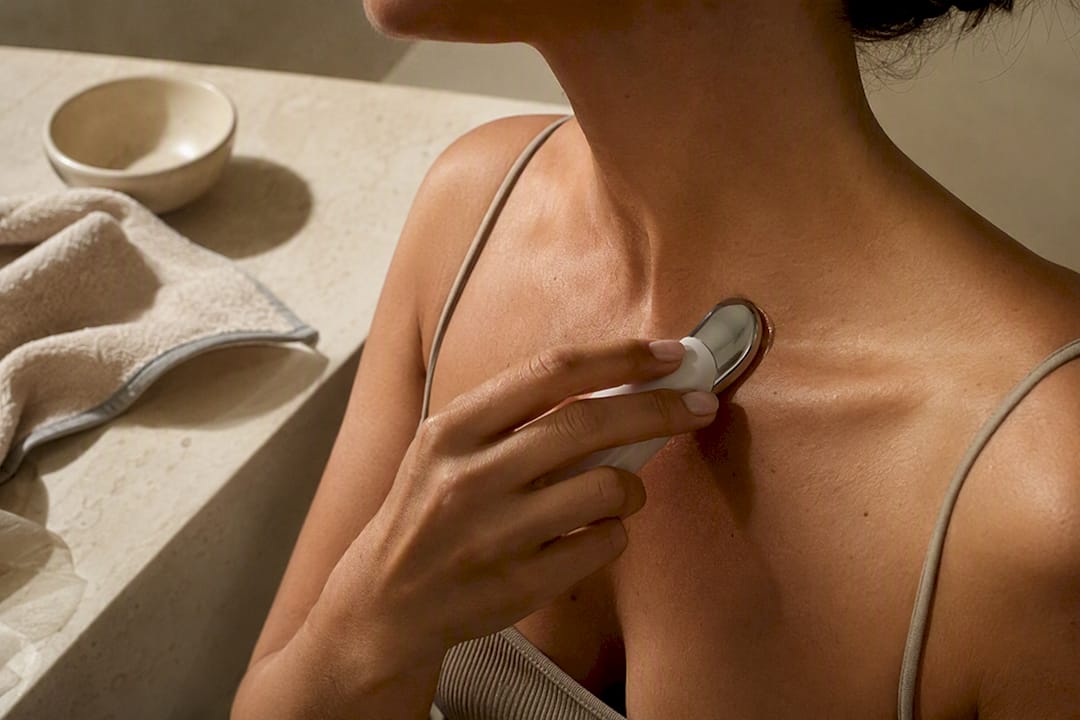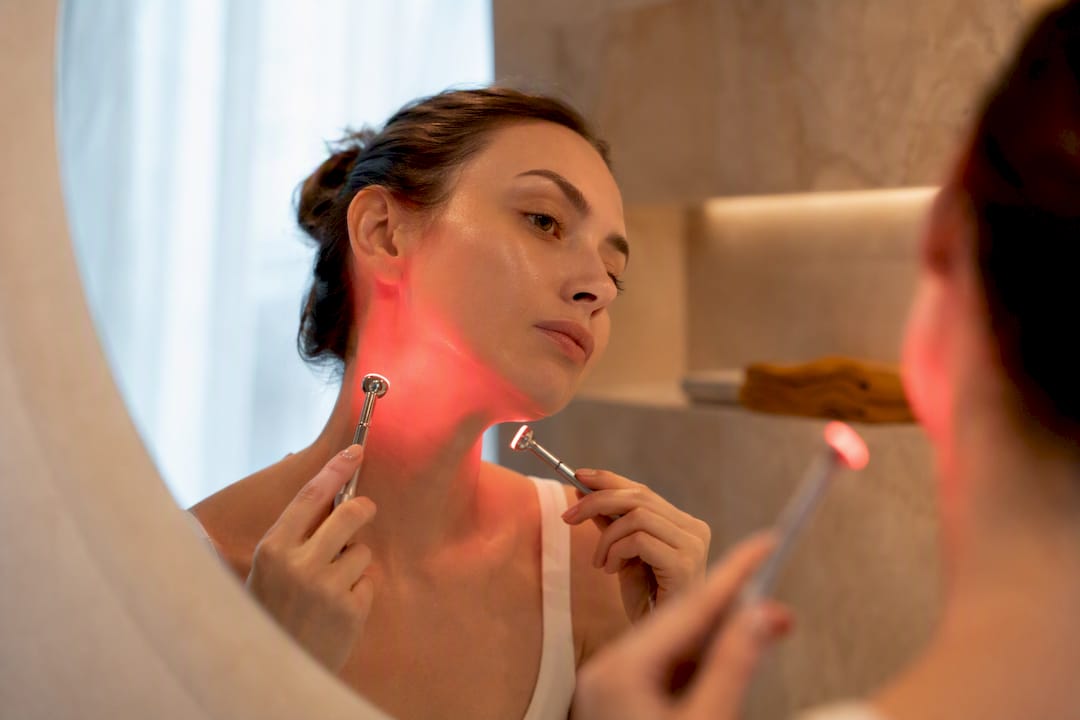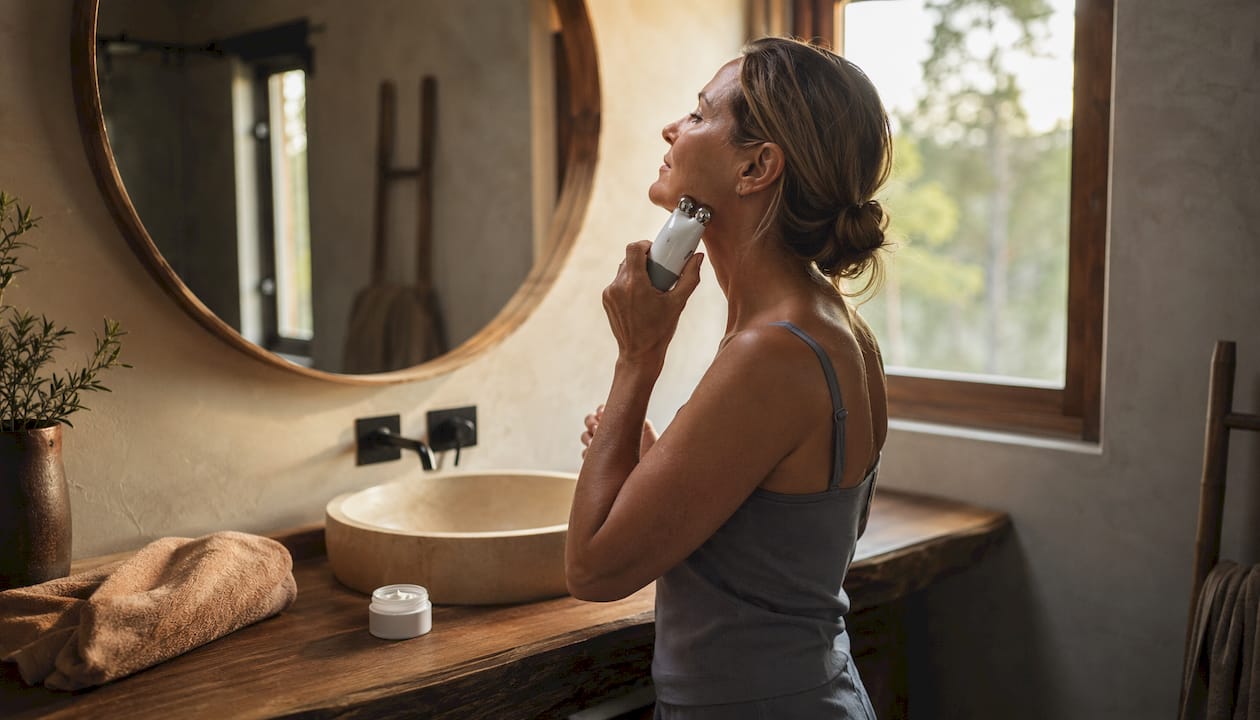
NuFACE is the better pick for most buyers. It holds FDA clearance and independent clinical data for facial lifting, works without an app, and starts at a lower price. ZIIP earns its place for users who want dual-waveform technology, app-guided treatment variety, and a focus on skin tone and cellular-level radiance rather than structural contouring.
The core trade-off is simple: NuFACE lifts and tones muscle. ZIIP targets skin quality at the cellular level. Neither is wrong. They just answer different questions.
- Price: NuFACE Mini+ starts at a lower price; ZIIP Halo is priced higher. NuFACE’s gel activator is less expensive per bottle compared to ZIIP’s Gold Gel Serum.
- App dependency: NuFACE works standalone. ZIIP’s full program library requires the ZIIP app and Bluetooth pairing.
- Timeline: Expect visible lifting from NuFACE in 2–4 weeks of daily use. ZIIP users typically report immediate brightness and cumulative tone improvements over 4–8 weeks.
Table of Contents
- What NuFACE offers today: models, price tiers, and who it suits
- What ZIIP offers today: models, the app ecosystem, and who it suits
- NuFACE vs ZIIP: side-by-side comparison
- How microcurrent and nanocurrent actually work, and why it matters
- Pros and cons for NuFACE and ZIIP
- Which device is right for you?
- How to choose: a practical decision framework
- How reviewers test these devices and what “I tested” claims actually mean
- Expert guidance and the research behind the recommendation
- Key Takeaways
- The case for choosing based on your actual routine, not the specs
- Shop NuFACE and ZIIP from an authorized source
- Further reading and sources
What NuFACE offers today: models, price tiers, and who it suits
NuFACE has built a clear product ladder. The NuFACE Mini+ is the entry point, delivering 335µA of microcurrent in a compact form with a simple 5-minute protocol. No app required, no attachments needed. It is the easiest way into the category.
The NuFACE Trinity and Trinity+ step up to a larger treatment head and a modular attachment system. The Trinity Pro is the top tier, outputting 600µA with a published independent clinical study showing measurable lift at 60 days of consistent daily use. The Fix MicroWand handles targeted precision work around the eyes and lips, and the NuBODY extends the platform to body applications.
Typical price ranges:
- NuFACE Mini+: entry-level starter kit
- NuFACE Trinity / Trinity+: mid-tier starter kits
- NuFACE Trinity Pro: premium tier
- Attachments (ELE, LED): sold separately
- Aqua Gel Activator: moderate cost per bottle
NuFACE suits users who want a proven, repeatable routine. The mental model is straightforward: clean skin, apply gel, slow glides, repeat daily. No app decisions, no Bluetooth pairing. For someone who wants visible facial contouring without learning a new software ecosystem, NuFACE is the cleaner choice.
Pros:
- FDA-cleared for facial toning; independent clinical studies on Trinity and Trinity Pro
- Works fully standalone, no app required
- Modular attachment system expands functionality over time
- Lower entry price and lower ongoing gel cost
Cons:
- Conductive gel is required every session and adds to long-term cost
- Larger Trinity devices are bulkier for travel
- Higher-tier attachments add significant cost
What ZIIP offers today: models, the app ecosystem, and who it suits
ZIIP’s product line is more focused. The ZIIP Halo is the flagship, a palm-sized device that blends nanocurrent and microcurrent in a dual-waveform system. The GX series shares the same underlying philosophy in alternate configurations. Where NuFACE gives you a device family with attachments, ZIIP gives you one well-engineered device and a rich software layer on top.

The ZIIP app is the real product. It houses six full-face treatments, six targeted sessions, and three treatment plans, each with visual tutorials and haptic feedback from the device to guide you through each zone. Without the app, you get one pre-programmed treatment. That is a meaningful limitation if you are not a consistent phone-during-skincare person.
Typical price ranges:
- ZIIP Halo: premium-priced device
- ZIIP base gel (included with device, refill): included or modest cost
- ZIIP Gold Gel Serum and premium formulas: higher cost options
ZIIP suits users who are motivated by guided programs, enjoy the ritual of a tech-forward routine, and care more about skin tone and radiance than structural lifting. ZIIP’s clinical data is primarily brand-conducted rather than independent peer-reviewed, and it does not hold FDA clearance. For users with sensitive skin, the sub-sensory nanocurrent is gentler than NuFACE’s higher-microamp output.
Pros:
- Dual-waveform technology (nanocurrent + microcurrent) targets both cellular repair and surface toning
- Extensive app-guided program library with haptic feedback
- Compact, lightweight, and easy to travel with
- Nanocurrent is gentler for sensitive skin
Cons:
- No FDA clearance; clinical evidence is primarily brand-conducted
- Full functionality requires the ZIIP app and Bluetooth pairing
- Gold Gel Serum is significantly more expensive than NuFACE gel
- No attachments or modular expansion
NuFACE vs ZIIP: side-by-side comparison
| Dimension | NuFACE Mini+ | NuFACE Trinity / Trinity Pro | ZIIP Halo | FOREO BEAR 2 |
|---|---|---|---|---|
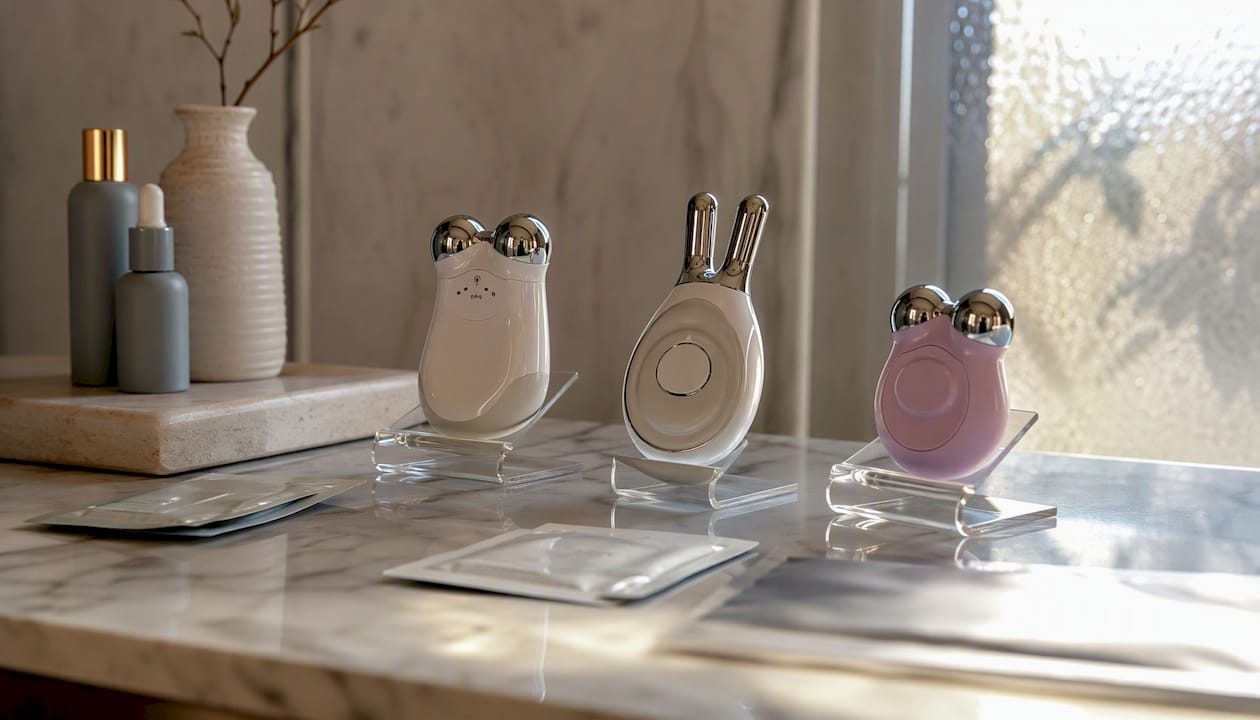
| Best for | Beginners, budget buyers | Lifting / contouring | Texture / radiance / app users | Gel-free, tech-forward users |
| Price | Entry-level pricing | Mid to high tier pricing | Premium pricing | Moderate pricing |
| Technology | Microcurrent (335µA) | Microcurrent (up to 600µA) | Nanocurrent + microcurrent (dual-waveform) | Microcurrent (71µA) + T-Sonic pulsation |
| App integration | Optional | Optional | Required for full library | Required for Anti-Shock System |
| Ease of use | Very easy, 5-min protocol | Easy, more surface area | Moderate; app-dependent | Moderate; app-dependent |
| Required consumables | Conductive gel (moderate cost per bottle) | Conductive gel (moderate cost per bottle) | Gold Gel Serum (higher cost options) | Conductive serum (no separate gel) |
| Comfort / safety | Sub-sensory to mild tingle | Perceptible microcurrent | Sub-sensory nanocurrent; gentler | Calibrated via app Anti-Shock System |
| Results timeline | Lifting in 2–4 weeks | Measurable lift at ~60 days (clinical) | Brightness immediately; tone in 4–8 weeks | Tone/texture in 3–8 weeks |
| Portability | Compact, USB-C charging | Larger, less travel-friendly | Very compact, lightweight | Compact, USB charging |
| Warranty | 2 years | 2 years | 1 year | 2 years |
NuFACE in one line: The FDA-cleared standard for at-home lifting, with the lowest entry price and the simplest daily protocol.
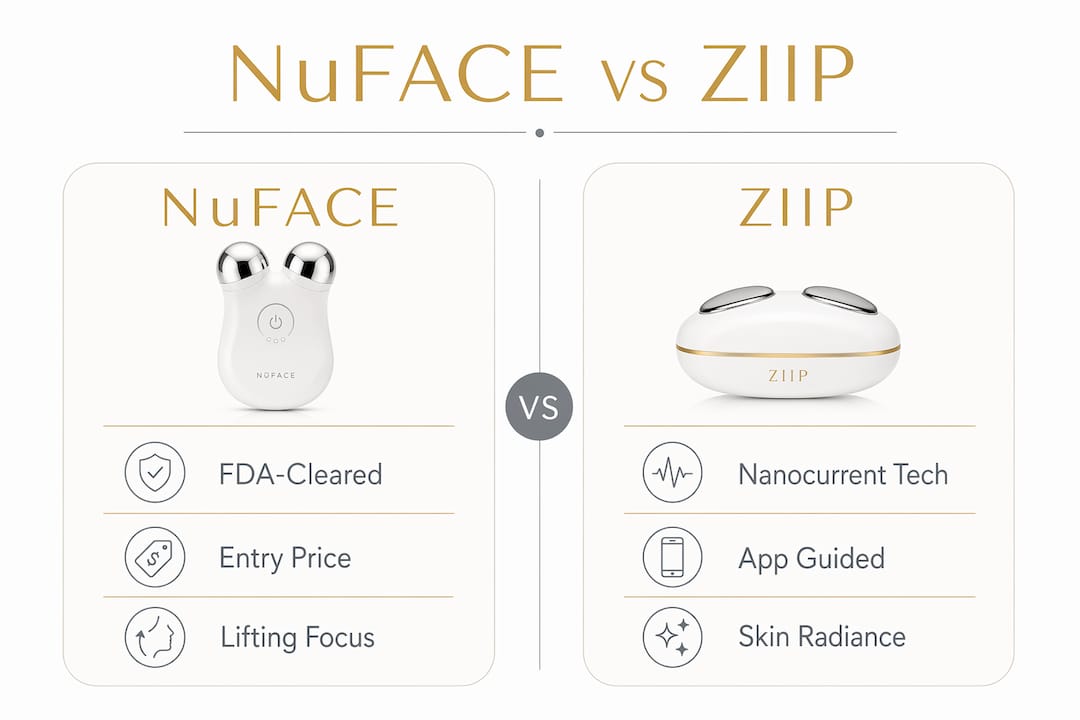
ZIIP in one line: The technology-first choice for skin quality, radiance, and app-guided variety, at a higher ongoing cost.
FOREO BEAR 2 in one line: The gel-free alternative for users who want a modern, app-guided experience with T-Sonic pulsation layered on top of microcurrent.
How microcurrent and nanocurrent actually work, and why it matters
Microcurrent and nanocurrent are both electrical stimulation technologies, but they operate at different scales and target different tissue layers.
Microcurrent (NuFACE’s primary mechanism) works in the range of hundreds of microamps. At that level, the current is strong enough to stimulate facial muscles, encouraging them to contract and re-educate over time. Think of it as a passive workout for the muscles underneath your skin. The result is the lifted, more defined contour that NuFACE is known for.
Nanocurrent (ZIIP’s differentiator) operates at sub-sensory levels, far below what you can feel. Rather than targeting muscle, it aims to stimulate ATP production at the cellular level, supporting collagen and elastin synthesis and skin repair. You do not feel it working, which is part of why ZIIP users describe the sensation as almost nothing compared to the perceptible tingle of NuFACE.
Microcurrents primarily target the muscle, whereas nanocurrents work more effectively at the cellular level, stimulating ATP, collagen, and elastin production. ZIIP’s dual-waveform system delivers both in a single session.
ZIIP’s app-guided sequences matter here because different programs emphasize different waveform ratios. A “brightening” protocol leans on nanocurrent; a “lifting” sequence adds more microcurrent. That variability is genuinely useful, but it also means the device’s value is tied to how consistently you engage with the app.
What those differences mean in practice:
- NuFACE produces more perceptible results faster for structural lifting and jaw definition
- ZIIP produces subtler, cumulative improvements in skin tone, texture, and radiance
- Sensitive skin users often tolerate ZIIP’s nanocurrent better than NuFACE’s higher microamp output
- NuFACE’s results are more predictable because the protocol is fixed; ZIIP’s results vary more by program choice and adherence
The FOREO BEAR 2 takes a third approach: 71µA microcurrent paired with T-Sonic pulsation. The pulsation is Foreo’s proprietary differentiator, claimed to relax facial muscles before current delivery. The output is notably lower than either NuFACE or ZIIP Halo at peak, but the gel-free conductance and app-guided Anti-Shock System make it a credible option for users who find gel application the biggest friction point in their routine.
Pros and cons for NuFACE and ZIIP
NuFACE
Pros:
- FDA clearance and published independent clinical data give it the strongest evidence base in the consumer microcurrent category
- Works completely standalone, no app, no Bluetooth, no phone required
- Lower entry price for Mini+ model and lower ongoing gel cost per bottle
- Modular Trinity platform grows with you via attachments
- 2-year warranty on higher-tier devices
Cons:
- Conductive gel is non-negotiable every session; skipping it reduces efficacy and risks skin irritation
- Trinity and Trinity Pro are bulkier than ZIIP Halo for travel
- No dual-waveform or nanocurrent component; purely microcurrent
ZIIP
Pros:
- Dual nanocurrent and microcurrent waveforms in one device
- App-guided programs with haptic feedback reduce guesswork
- Compact and lightweight, genuinely travel-friendly
- Gentler sensation suits sensitive skin better than high-microamp devices
Cons:
- No FDA clearance; clinical evidence is brand-conducted, not independent
- Full functionality requires the ZIIP app; limited without it
- Gold Gel Serum costs notably more per bottle compared to NuFACE gel
- Warranty period is shorter than NuFACE’s coverage at similar price levels
Pro Tip: If gel cost is a real budget concern, calculate your annual consumable spend before buying. NuFACE’s gel lasts for multiple weeks per bottle (~$29 per bottle), while ZIIP’s Gold Gel Serum is more expensive (~$95 per 80 ml) for a similar usage period. This difference can add up to a significantly higher annual cost for ZIIP gel.
Which device is right for you?
Beginner: NuFACE Mini+ wins. The 5-minute protocol is easy to build into a daily habit, no app required, and the entry price is lower. You can always upgrade to Trinity later.
Budget-minded buyer: NuFACE again. The Mini+ is $190 less than ZIIP Halo at purchase, and the ongoing gel cost is a fraction of ZIIP’s Gold Gel Serum.
Serious contouring and lifting: NuFACE Trinity or Trinity Pro. The FDA-cleared, clinically validated lifting protocol is the closest at-home equivalent to a professional microcurrent facial. No other consumer device at this price matches its evidence base.
Texture, radiance, and skin quality: ZIIP Halo. The nanocurrent component targets ATP and cellular repair in a way pure microcurrent devices do not. If your priority is glow and skin tone rather than jaw definition, ZIIP is the more targeted tool.
App and tech enthusiast: ZIIP Halo. Six full-face programs, six targeted sessions, haptic feedback, and a well-designed app make it the most software-rich experience in the category.
Sensitive skin: ZIIP Halo or FOREO BEAR 2. Both operate at lower or sub-sensory current levels. ZIIP’s nanocurrent is genuinely gentler; FOREO’s Anti-Shock System calibrates intensity to your skin’s conductance in real time.
Combining devices: Some users run NuFACE for lifting sessions and ZIIP for tone and texture on alternate days. That is a legitimate approach, but do not use both in the same session. If you have sensitive skin, rosacea, or any active skin condition, consult a dermatologist before layering electrical treatments.
How to choose: a practical decision framework
Decision checklist
- What is your primary goal? Lifting and contouring point to NuFACE. Skin tone, texture, and radiance point to ZIIP.
- How much time per session? NuFACE Mini+ is 5 minutes. ZIIP baseline facial is about 4 minutes, but app setup adds time.
- Will you actually use an app every session? If the honest answer is “probably not,” ZIIP’s value drops significantly.
- What is your total budget, including consumables? Factor in gel costs annually, not just device price.
- Do you want attachments or modular expansion? NuFACE Trinity supports them; ZIIP does not.
Questions to ask before buying
- Is the seller an authorized retailer? Counterfeit microcurrent devices are a real problem in this category.
- What is the return window? NuFACE and ZIIP both offer return policies, but terms vary by retailer.
- Does the warranty cover the full device, or just components?
Costs at a glance
| Item | NuFACE Mini+ | NuFACE Trinity Pro | ZIIP Halo |
|---|---|---|---|
| Device price | Entry-level pricing | Premium tier pricing | Premium pricing |
| Gel / serum cost per bottle | Modest cost | Modest cost | Higher price range |
| Estimated annual gel spend | Lower annual cost | Lower annual cost | Higher annual cost |
| Warranty | 2 years | 2 years | 1 year |
Results timeline and frequency
- Weeks 1–2: Both devices produce some immediate brightness or temporary lift after each session. This is real but not cumulative yet.
- Weeks 3–4: NuFACE users typically notice more defined contour. ZIIP users report improved skin tone and texture.
- Weeks 5–8: Cumulative lifting from NuFACE becomes more consistent. ZIIP’s cellular improvements in radiance and skin quality become more visible.
- Week 12+: Maintenance phase. Both brands recommend dropping to 2–3 sessions per week once results are established.
For the first 60 days, daily use is standard for NuFACE. ZIIP recommends three sessions per week for most programs. Skipping sessions is the single biggest reason people do not see results from either device.
Safety note: Avoid microcurrent devices if you have a pacemaker, metal implants in the face, active acne, open wounds, or are pregnant. Always follow the manufacturer’s contraindication list and consult a physician if you have any underlying conditions.
How reviewers test these devices and what “I tested” claims actually mean
Most hands-on reviews of NuFACE and ZIIP follow a similar structure, and knowing what that structure looks like helps you judge whether a verdict is trustworthy.
A credible review protocol typically includes:
- Consistent use for a minimum of 4–8 weeks (shorter testing periods capture only temporary effects, not cumulative results)
- Before-and-after photos taken under identical lighting conditions, ideally at the same time of day
- Disclosure of any paid partnership, gifted product, or affiliate relationship with the brand
- Notes on skin type, baseline condition, and any other treatments used during the test period
- Honest reporting of protocol adherence, including missed sessions
What to watch for:
- Reviews shorter than 4 weeks are capturing brightness and temporary lift, not structural change
- “I noticed a difference immediately” is real but not the same as sustained improvement
- Reviews that do not disclose affiliate links should be read with some skepticism in this category
The distinction between immediate and cumulative results matters. Brightness after a single ZIIP session is a real effect, likely from increased circulation and ATP stimulation. The structural lifting NuFACE is known for takes consistent muscle re-education over weeks. Both are legitimate outcomes. They just operate on different timescales and through different mechanisms.
Expert guidance and the research behind the recommendation
The reviewer and expert consensus on NuFACE vs ZIIP has been consistent across multiple hands-on comparisons: choose NuFACE for structural lifting and clinical reliability; choose ZIIP for skin tone, texture, and app-guided treatment variety.
That split is grounded in real differences in evidence quality. NuFACE Trinity and Trinity Pro hold FDA clearance for facial toning and are backed by published independent clinical studies. ZIIP does not hold FDA clearance, and its clinical data comes primarily from brand-conducted research. That does not make ZIIP ineffective. It means the evidence standard is different, and buyers should weigh that accordingly.
The most important factor for results with either device is not which one you buy. It is whether you use it consistently. Expert commentary across multiple reviews converges on one point: adherence to the protocol matters more than any feature difference between devices.
A 2017 study published in the Journal of Clinical and Aesthetic Dermatology showed significant improvements in facial contour after 12 weeks of consistent microcurrent use at output levels consistent with NuFACE devices. NuFACE cites 85% user-reported improvement in facial contour after 60 days. Those figures are meaningful, but they assume daily use.
Practical tips for maximizing results from either device:
- Apply enough conductive gel. Thin gel application is the most common technique error and reduces both efficacy and comfort.
- Move slowly. Rushing the glide reduces the time the current has to work on each muscle group.
- Be consistent before you evaluate. Give either device at least 8 weeks before deciding it is not working.
- Budget for consumables before you buy the device. Gel costs are the most common reason users abandon microcurrent routines.
- If app guidance helps you stay consistent, ZIIP’s program library is a genuine asset. If the app adds friction, NuFACE’s standalone protocol is the better fit.
The FOREO BEAR 2 is worth mentioning here as a third option for users who find gel the biggest barrier. Its gel-free, serum-based conductance removes one step from the routine, which genuinely improves adherence for some users. The trade-off is lower microcurrent output (71µA versus NuFACE Mini+’s 335µA) and mandatory app dependency for the Anti-Shock System.
Key Takeaways
NuFACE is the stronger choice for most buyers: FDA-cleared, clinically validated for lifting, lower entry price, and no app required.
| Point | Details |
|---|---|
| NuFACE for lifting | FDA clearance and independent clinical studies make NuFACE the evidence-backed choice for structural contouring. |
| ZIIP for skin quality | Dual nanocurrent and microcurrent waveforms target cellular repair, tone, and radiance more directly than pure microcurrent. |
| Consumable costs matter | ZIIP’s Gold Gel Serum (higher cost options) costs significantly more annually than NuFACE’s Aqua Gel Activator (~$29 per bottle). |
| App dependency is a real trade-off | ZIIP’s full program library requires the app; NuFACE works standalone, which reduces daily friction and supports better adherence. |
| Glowera stocks both | Glowera carries NuFACE Mini+, ZIIP Halo, and compatible consumables from authorized sources, with shipping across the EU and UK. |
The case for choosing based on your actual routine, not the specs
There is a version of this comparison that ends with “ZIIP wins on technology.” Dual waveforms, nanocurrent, ATP stimulation, a polished app. On paper, it sounds like the more advanced device. And for a certain kind of buyer, it is.
But the most honest thing to say about NuFACE vs ZIIP is that the better device is the one you will actually use every day. NuFACE’s 5-minute standalone protocol has one real advantage that no spec sheet captures: it is easy to do without thinking. No phone, no Bluetooth, no program selection. Apply gel, glide, done. That simplicity is why NuFACE has the clinical data it does. People actually complete the protocol.
ZIIP is genuinely excellent for users who are motivated by guided programs and enjoy the ritual of an app-connected routine. The nanocurrent technology is not marketing. It does something different from microcurrent alone, and the results in skin tone and texture are real. But if you are the kind of person who will leave the app unopened after week two, ZIIP’s main advantage disappears.
The FOREO BEAR 2 sits in its own lane. It is not the strongest lifter and it is not the most feature-rich. What it does is remove the gel step entirely, which for some users is the difference between a routine they keep and one they abandon. That is a legitimate reason to choose it.
Buy the device that fits the routine you will actually maintain, not the one with the most impressive feature list.
Shop NuFACE and ZIIP from an authorized source
Both NuFACE and ZIIP are worth buying only from an authorized retailer. Counterfeit microcurrent devices are common in this category, and a fake device will not deliver the output levels the clinical data is based on.
Glowera stocks the NuFACE Mini+ Starter Kit, the ZIIP Halo, and compatible conductive gels and serums, all 100% authentic from brand-authorized supply. Every device ships with full warranty coverage. If you are ready to compare models side by side or check current availability, the microcurrent device category at Glowera has both brands in one place. Free shipping thresholds apply, and the team is available for device-specific questions before you commit to a purchase.
Further reading and sources
- NuFACE Trinity Pro vs ZIIP Halo comparison — Celliara hands-on review with clinical evidence summary
- NuFACE Trinity+ vs ZIIP Halo: Microcurrent vs Nanocurrent — Detailed waveform and consumable cost breakdown
- NuFACE Mini Plus vs FOREO BEAR 2 — Entry-level device comparison with output specs
- FOREO BEAR 2 Review: Gel-Free Microcurrent — Adherence and consumable friction analysis
- ZIIP Halo vs NuFACE Mini: Glamour and Gains — Reviewer consensus on lifting vs texture split
- NuFACE vs ZIIP: mindbodygreen hands-on — First-person testing notes and usability comparison
- FOREO BEAR vs NuFACE: MinJi in Seoul — Buyer-fit framing and routine-match analysis
- Journal of Clinical and Aesthetic Dermatology — microcurrent study — Peer-reviewed clinical data on microcurrent and facial contour
- NuFACE Mini+ Starter Kit at Glowera — Authorized purchase page
- ZIIP device at Glowera — Authorized purchase page
- Microcurrent device category at Glowera — Full range of NuFACE, ZIIP, and FOREO devices
This article is general information for educational purposes. It is not medical advice. Consult a dermatologist or licensed esthetician before starting any electrical stimulation treatment, particularly if you have underlying skin conditions, implanted devices, or are pregnant.